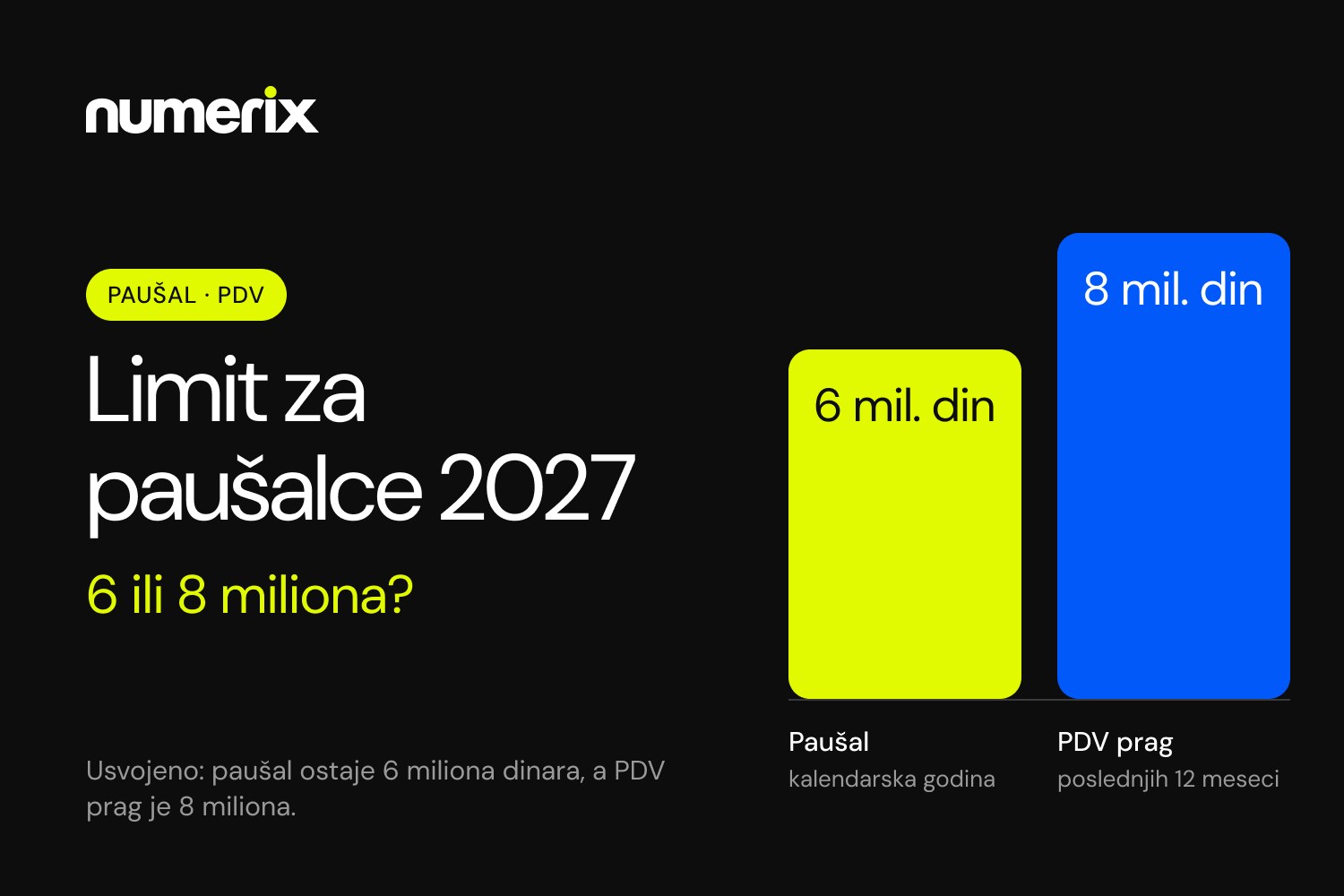

Throughout 2026, a lot was written about the limit for paušalci (flat-rate taxed entrepreneurs) rising to 8 million dinars. The headlines spread across news portals and social media, and many entrepreneurs had already started planning their invoicing accordingly. That is why it is important to say it clearly: for 2027, the flat-rate taxation limit remains 6,000,000 dinars. The 8 million figure is still the threshold for entering the VAT system – and that is an entirely different rule, calculated in a different way.
In this article we explain what was actually adopted, how both limits are calculated, what happens when you exceed them and what to check before it is too late.
What was actually adopted for 2027
On 31 August 2026, the National Assembly adopted a package of tax law amendments, published in the Official Gazette of the Republic of Serbia („Službeni glasnik RS“) No. 80/2026 of 31 August 2026, which entered into force on 8 September 2026. Among them are amendments to the Personal Income Tax Law (Zakon o porezu na dohodak građana) and the VAT Law (Zakon o PDV). Most of the new rules apply from 1 January 2027.
For paušalci, three things are key:
- The flat-rate limit has not changed. Article 40 of the Personal Income Tax Law still provides that an entrepreneur whose turnover exceeds 6,000,000 dinars is not entitled to flat-rate taxation. The increase to 8 million was a business-community proposal from the public consultation, but it did not make it into the adopted law.
- The VAT threshold remains 8,000,000 dinars of turnover in the previous 12 months.
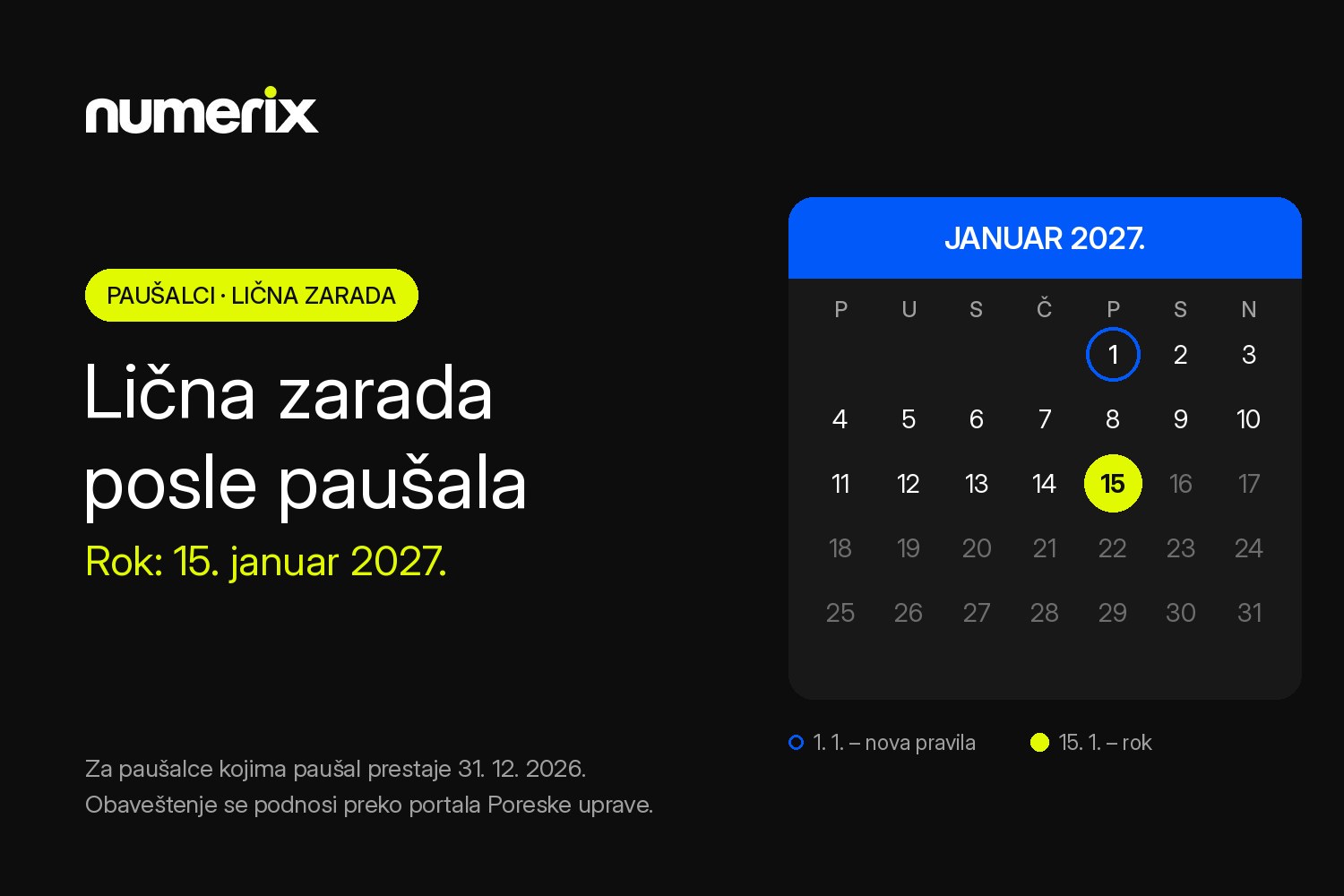
- New: lična zarada (personal salary) immediately after losing flat-rate status. From 1 January 2027, a paušalac who loses the right to flat-rate taxation may opt to pay themselves a personal salary within 15 days of the date that right ceased (amended Article 33a), counting from the date from which you keep books, until the Tax Administration (Poreska uprava) issues a different interpretation. Until now, this choice had to be filed by 15 December and applied only from 1 January of the following year.
So where does the confusion come from? From the fact that a paušalac actually tracks two limits – 6 and 8 million – which are calculated in different ways.
The flat-rate limit: 6 million per calendar year
The 6 million flat-rate limit looks at the calendar year, from 1 January to 31 December. It includes total turnover – from both domestic and foreign clients. The primary data source is the KPO book (knjiga o ostvarenom prometu paušalaca – the flat-rate turnover ledger), together with turnover on the business account.
What happens when you exceed 6 million
Exceeding 6 million does not mean a special tax on the amount above the limit. It means that the right to flat-rate taxation ends and you switch to keeping business books and being taxed on actual profit. Under Article 42 of the Personal Income Tax Law, the Tax Administration orders bookkeeping by a formal decision (rešenje):
- from 1 July of the current year, if the limit was exceeded between 1 January and 30 June;
- from 1 January of the following year, if the limit was exceeded between 1 July and 31 December.
Until the date stated in the decision, you are still a paušalac. From that date you keep books and, within 15 days, file a tax return for the switch to taxation on actual income. From 2027, within the same 15-day deadline, you can also opt for a personal salary. For an entrepreneur with higher profit this is usually more favourable, because contributions are paid only on the chosen personal salary, not on the entire taxable profit as with self-assessment (samooporezivanje).
Switching to bookkeeping and the request for the following year
If your turnover in 2026 exceeded 6 million, you cannot be a paušalac in 2027. Conversely, anyone who kept books and wanted to switch to flat-rate taxation from 2027 had to file a request by the deadline, which this year expired on Monday, 2 November 2026 (the statutory deadline of 31 October fell on a Saturday). For 2028, the next such deadline is 1 November 2027, because 31 October 2027 falls on a Sunday. The request is filed through the ePorezi portal, which also works at weekends, so it is safer not to wait until the last day.
The 8 million VAT threshold: a rolling 12-month period
The VAT threshold for 2027 stays the same: 8,000,000 dinars of total turnover in the previous 12 months (Article 38 of the VAT Law). The key words are “previous 12 months”. This is not the calendar year but a rolling 12-month period – the total is checked continuously, for the last twelve months, regardless of when the year begins.
Not all turnover counts towards this threshold. Services to foreign companies (B2B) where the place of supply is abroad as a rule do not count towards this total. Exports of goods do count, and services to foreign individuals often have their place of supply in Serbia, so they count too. That is why, for freelancers, the difference between the two limits is often large. If you are not sure where the place of supply is for your service, that is a question for a professional check, not for guesswork.
Example: how the rolling period catches you out
An entrepreneur invoices domestic clients 700,000 dinars a month, from September 2026 onwards.
- At the end of August 2027, turnover in calendar year 2027 amounts to 5,600,000 dinars – below the flat-rate limit.
- But for the last 12 months (September 2026 – August 2027) the total is 8,400,000 dinars – the VAT threshold was already exceeded during August.
The same entrepreneur would therefore stay within the flat-rate limit for the calendar year, yet would still have to enter the VAT system. That is why looking only at year-to-date turnover is not enough.
What happens when you exceed the VAT threshold
- VAT registration application (evidenciona prijava) within five days of the day turnover in the previous 12 months exceeded 8 million (Article 38 of the VAT Law; this deadline applies from 2025). The application is filed electronically through the ePorezi portal.
- Flat-rate status ends. An entrepreneur who is a VAT payer cannot be a paušalac (Article 40 of the Personal Income Tax Law) and must keep business books at the latest from the day they become a VAT payer, without a separate decision (Article 42).
- Staying in the VAT system. Under the amendments in Official Gazette No. 80/2026, the obligation to pay VAT for anyone who exceeds the threshold lasts at least for the current and the following calendar year. This is a new rule, since until now the two-year period applied only to voluntary registration.
- Delay is costly. If you do not file the registration application on time, the tax authority may register you ex officio, and you are entitled to deduct input VAT only from the day the registration application is filed.
Exceeding the VAT threshold is therefore a more serious event than exceeding the flat-rate limit: the consequences apply immediately, not from 1 July or 1 January.
The self-employment test (test samostalnosti) – in brief
The adopted amendments do not change the self-employment test. It continues to apply to entrepreneurs regardless of the limits, with the same criteria as before. If you earn most of your income from a single client, check the test separately – we will cover it in a separate article.
A practical checklist for paušalci ahead of 2027
Track both totals after every invoice
In addition to year-to-date turnover (for the 6 million limit), keep a total for the last 12 months (for the 8 million VAT threshold). A single table with two columns is enough, as long as it is updated regularly.
Separate turnover from foreign clients
It counts towards the 6 million limit, but as a rule not towards the VAT threshold. If you do not separate it, you do not know how close you really are to the VAT threshold.
Set yourself an early alarm
For example, at 80% of each limit – 4.8 million for flat-rate taxation and 6.4 million for VAT. That leaves time to talk to your accountant and plan.
Include planned invoices too
A large project invoiced in December or January can “spill over” both limits. Look at what has been contracted until the end of the year, not only at what has already been invoiced.
Decide in advance what you will do if you exceed a limit
Personal salary or self-assessment, who will keep your business books, how your prices change if you enter VAT. The 15-day deadline for a personal salary and the five-day deadline for VAT registration are too short to decide on the fly.
Why this is worth tracking systematically
Most problems with limits arise not from not knowing the rules, but because nobody looks at the numbers in time. At Numerix we believe in a simple model: you keep your records with the help of modern tools, and we review them regularly – including both limits – and warn you before a limit is crossed, not after.
In short
- The flat-rate limit in 2027 remains 6,000,000 dinars per calendar year; 8 million was not adopted.
- The VAT threshold remains 8,000,000 dinars over a rolling 12-month period.
- Exceeding 6 million: bookkeeping from 1 July or from 1 January of the following year, by decision of the Tax Administration.
- Exceeding 8 million: VAT registration application within five days and the end of flat-rate status from the day you enter VAT.
- From 2027: a personal salary is possible within 15 days of losing flat-rate status.
Not sure where you stand relative to the limits?
If you are approaching one of the limits or planning a larger job at the end of the year, get in touch. The Numerix team can review your KPO book and your turnover for the last 12 months and show you how much room you really have – and what the best next step is.
Sources: Personal Income Tax Law (Zakon o porezu na dohodak građana), Articles 33a, 40 and 42 (amendments, „Sl. glasnik RS“ No. 80/2026); Value Added Tax Law (Zakon o porezu na dodatu vrednost), Article 38 (amendments, „Sl. glasnik RS“ Nos. 94/2024, 109/2025 and 80/2026); KPMG, „Usvojene su izmene i dopune Zakona o porezu na dodatu vrednost“ (2026); Law Amending the Personal Income Tax Law (text adopted by the National Assembly, parlament.gov.rs); Paragraf – „Prelazak preduzetnika sa paušalnog oporezivanja na oporezivanje prema stvarno ostvarenom prihodu“. This article is for information purposes only and does not constitute a tax opinion.