
Many paušalci (flat-rate taxed entrepreneurs) work for a single client – often a Serbian company or a foreign one – and have no problems for years. But when that relationship in practice resembles employment, the Personal Income Tax Law (Zakon o porezu na dohodak građana) has an answer: the self-employment test (test samostalnosti). If you fail it, the fee from that client is no longer taxed as income from self-employment but as “other income” (drugi prihod) – with considerably higher tax and contributions.
In this article we explain what the self-employment test for entrepreneurs is, all nine criteria, what happens if you fail it, who pays the difference and how to check for yourself where you stand – whether you are an entrepreneur or a company that engages entrepreneurs.
What is the self-employment test?
The self-employment test is set out in Article 85, paragraph 1, item 17) of the Personal Income Tax Law and has applied since 1 March 2020. It checks whether an entrepreneur – a paušalac or an entrepreneur who keeps business books – is genuinely independent in relation to a specific client (nalogodavac), or is in fact a disguised employee.
The test is always carried out for each relationship separately: one entrepreneur and one client (together with persons related to that client within the meaning of the corporate income tax law). The same entrepreneur can be independent in relation to one client and dependent in relation to another.
The client can be a Serbian or foreign legal entity, an entrepreneur or a flat-rate entrepreneur who directly or indirectly engaged the entrepreneur. An intermediary or agent who merely passes on the fee for a customary commission is not considered the client – in that case the client is the person on whose behalf the payment is made.
How many criteria “fail” the test
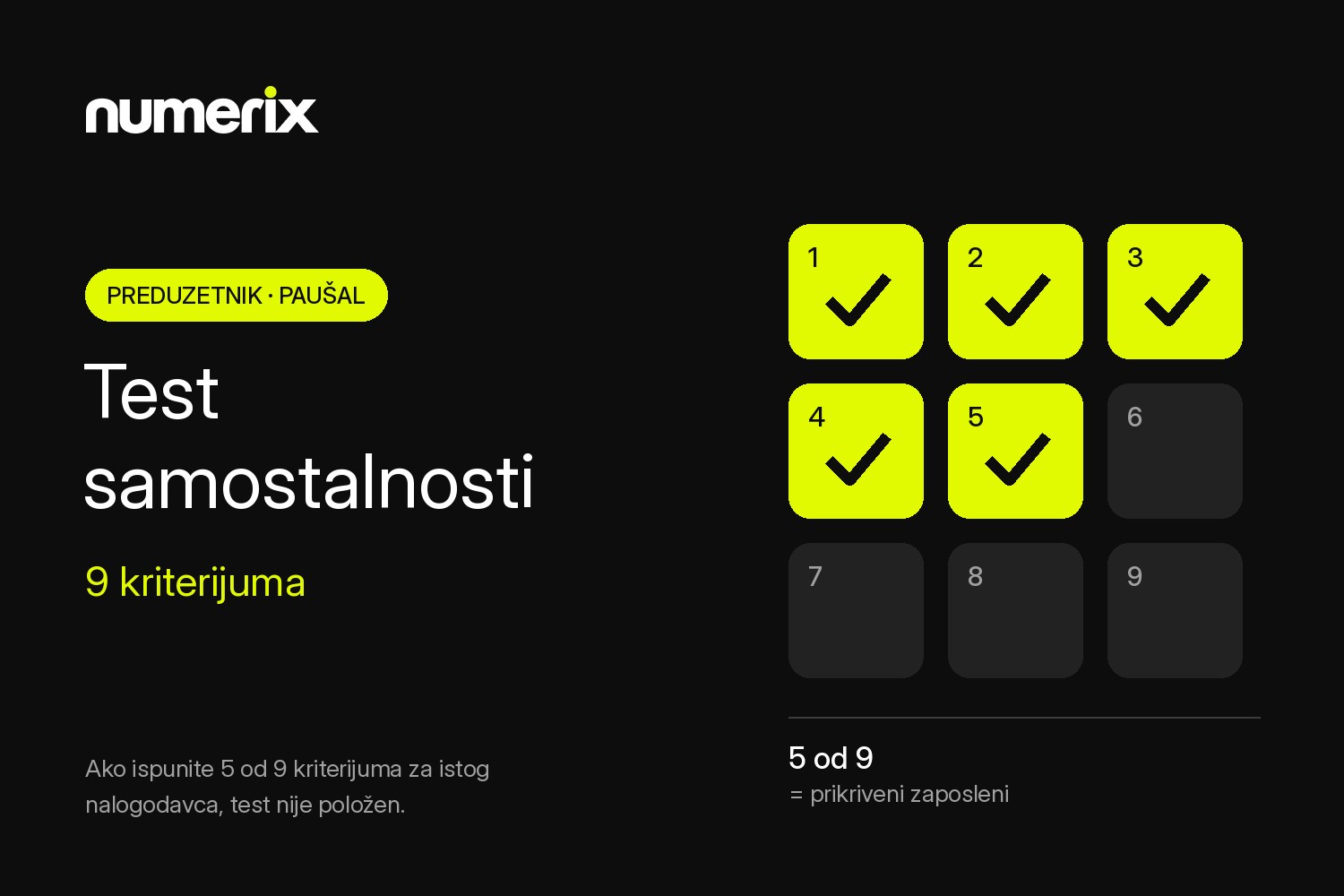
An entrepreneur is considered dependent if, in relation to the same client, they meet at least five of the nine criteria. It is also sufficient if, at the start of the cooperation, it could be concluded from the circumstances that five criteria would be met, provided they are actually met later. With up to four criteria met, the test is passed.
The self-employment test: 9 criteria
1. Working hours and leave
The client determines your working hours, or your holidays and absences depend on the client’s decision, and your fee is not reduced for time spent on holiday.
2. Premises and place of work
You usually work on premises provided by the client or at a place the client determines.
3. Training and professional development
The client provides or organises your professional training or development.
4. Method of engagement
You were engaged following an advertisement in which the client was looking for people to work, or through a third party that recruits staff (e.g. an employment agency).
5. Equipment and management of work
The client provides or finances the basic tools, equipment or other resources for your regular work (except specialised resources for a specific job), or usually manages the process of your work – beyond giving a basic assignment and reasonable control of results.
6. 70% of income from one client
At least 70% of your total income in a 12-month period that begins or ends in the tax year comes from one client (or persons related to them). This is the criterion that paušalci with a single client almost always meet.
7. Work in the client’s line of business, without business risk
You do work within the client’s line of business, and the contract contains no clause under which you bear the usual business risk for the work delivered to the client’s customer.
8. Ban on working for others
The contract partially or fully prohibits you from working for other clients. The exception is a partial ban relating to a limited number of the client’s direct competitors.
9. 130 or more working days
You work for the same client for 130 or more working days in a 12-month period that begins or ends in the tax year. Every working day on which you did any work for the client counts as a full day.
What if you fail the self-employment test
If five or more criteria are met, the fee from that client is taxed as other income:
- 20% tax on gross income – without standardised expenses (Article 85, paragraph 5, item 1) and Article 86).
- Pension and disability insurance contribution (PIO) on the same base. The health contribution is as a rule not paid, because you are already insured on the basis of your business activity.
- This income does not count as turnover for the 6 million dinar flat-rate taxation limit (Article 40), and for an entrepreneur who keeps books it is not included in taxable income from self-employment (Article 37v).
Important: failing the test does not automatically mean the end of flat-rate status. The consequence relates to the income from the specific client – but that income becomes much more expensive.
Who pays: a Serbian or a foreign client
- A Serbian client (legal entity or entrepreneur) is the payer and must calculate and pay the tax and contribution by withholding, on every payment. If it fails to do so and a tax inspection establishes dependence, the liability with interest falls on the client, with possible misdemeanour liability. That is why the self-employment test is just as much an issue for companies that engage entrepreneurs.
- A foreign client does not calculate tax in Serbia. In that case the entrepreneur calculates and pays the tax themselves (by self-assessment – samooporezivanje, Article 100a) and files a tax return within 30 days of the date the income was received (Article 95).
Example: a paušalac with one client
The example is fictitious and serves only as an illustration.
Ana is a paušalac and a programmer. She invoices all her income, 250,000 dinars a month, to one Serbian company. She works from 9 am to 5 pm, using the company’s laptop and accounts, attends meetings at the office twice a week, and coordinates her annual leave with the team. She was engaged through a job advertisement, and her contract prohibits her from working for other clients.
Criteria review: working hours (1), place of work (2 – probably, depending on what is “usual”), method of engagement (4), equipment (5), 70% of income (6), ban on working for others (8), 130+ working days (9). That is six or seven criteria – the test is failed.
For 12 months (3,000,000 dinars gross), if the fee is treated as gross, the 20% tax amounts to 600,000 and the PIO contribution to 720,000 dinars – a total of around 1,320,000 dinars, on top of the regular flat-rate tax and contributions, which still apply. A Serbian company withholds and pays the tax and PIO at each payment; with a foreign client, the paušalac pays them himself (samooporezivanje) within 30 days. This fee does not count toward the 6 million dinar limit for paušalci. If the company paid the full amount without withholding, in an inspection the amount paid may be treated as net, so the base is grossed up and the liability is even higher.
The same work, organised differently – her own equipment, her own working hours, several clients, a contract with responsibility for results – could fall to four or fewer criteria.
Checklist: check yourself for each client
For each relationship with a client, answer “yes” or “no”:
- Does the client set my working hours or approve my leave?
- Do I usually work on their premises or at a place they determine?
- Do they organise or pay for my training?
- Was I engaged through a job advertisement or an employment agency?
- Do I use their basic equipment, or do they manage my work?
- Does 70% or more of my income over 12 months come from them?
- Do I work in their line of business without a business-risk clause?
- Does my contract prohibit me from working for others?
- Do I work for them 130 or more working days in 12 months?
Five or more “yes” answers mean it is time for a serious check. In addition:
- Check periodically, not only when signing the contract – criteria 6 and 9 change during the year.
- Align the contract with practice. The Tax Administration (Poreska uprava) looks at how the cooperation actually works, not only at what the contract says.
- Keep evidence: contracts, invoices to other clients, receipts for your own equipment, project records.
- Companies that engage entrepreneurs should carry out the test for each of them and document the conclusion, because they are the withholding taxpayer.
The Tax Administration has also published Guidelines for applying the self-employment test in tax inspections, which show how inspectors approach the assessment.
In short
- The self-employment test has 9 criteria; you are dependent if you meet at least 5 for the same client.
- The test is carried out for each client separately, over a 12-month period.
- Consequence: 20% tax and PIO contribution on gross income, without standardised expenses.
- With a Serbian client, the client pays by withholding; with a foreign one – the entrepreneur pays, within 30 days.
- Paušalci with one client almost always meet criterion 6, which leaves them less room on the others.
Not sure whether you pass the test?
If you are a paušalac with one main client, or a company working with several entrepreneurs, get in touch. The Numerix team can go through your contracts and the actual organisation of your work, criterion by criterion, and show you where the risk lies and what can be changed. Read more on our Tax advisory page or through the Tax Health Check.
This article is for information purposes only and does not constitute a tax opinion for a specific case.