
With the electronic record of input VAT (evidencija prethodnog poreza, EPP) and internal invoices in the Electronic Invoicing System (SEF), two dates are often mixed up: the 10th and the 12th of the month. These are not two filing deadlines for two different records. All SEF records — the input VAT record (EPP) and the VAT calculation record, including the internal invoice — must be filed by the 12th of the month following the tax period. The 10th has a different role: it is the last day by which you must accept an e-invoice or draw up an internal invoice if you want to deduct input VAT in that period. The VAT return remains due on the 15th.
This article separates those three deadlines, explains what goes into the input VAT record, how an internal invoice is drawn up in SEF, and what changes from January 2027, when EPP starts feeding the preliminary VAT return.
Three deadlines, three tasks
For a monthly taxpayer, after the tax period ends, the sequence is as follows:
- no later than the day before the VAT return is filed, and no later than the 10th – accept incoming e-invoices and draw up internal invoices if you want to deduct input VAT in that period;
- by the 12th – file the input VAT record and the VAT calculation record in SEF;
- by the 15th – file the VAT return and pay the VAT.
The same dates apply to a quarterly taxpayer, counted from the end of the quarter. For example, the EPP for October, or for the third quarter, is filed by 12 November.
The old deadline of “10 days after the end of the period” no longer applies: for periods from January 2025 onwards, the deadline for SEF records is the 12th day of the following month.
What is the input VAT record?
The input VAT record (EPP) is a summary presentation of input VAT in the Electronic Invoicing System, for a tax period — a calendar month or a quarter. It is filed by the VAT payer, regardless of whether the input VAT being recorded may actually be deducted.
EPP contains, in aggregate:
- purchases from VAT payers, by source: electronic invoices, fiscal receipts and other invoices;
- purchases for which the recipient is the person liable for VAT (reverse charge), taken from the individual VAT records — internal invoices, separately for a “foreign person” and separately for a “VAT payer”;
- VAT paid on import, the VAT compensation paid to a farmer, and corrections of the input VAT deduction.
Amounts are stated in dinars, with no more than two decimal places.
The EPP deadline: the 12th of the month, with a cut-off on the 10th
EPP is filed after the tax period ends, no later than the 12th day of the calendar month following that period. This includes increases and decreases.
The data are not taken “at the moment you click” without a rule. EPP is filed as at the day preceding the filing day. If you file it on the 11th or the 12th, the system takes the data as at the 10th of that month.
That is why it makes little sense to leave invoice acceptance and internal invoices until the 11th or the 12th. Even if you file the EPP by the 12th, the data are taken as at the 10th. An internal invoice that did not yet have the status “recorded” (evidentirano) by then will not automatically enter the EPP. An e-invoice that has not been accepted by the 10th will appear in the EPP, but you cannot deduct the VAT on it in that period.
The internal invoice in SEF and the VAT calculation record
An internal invoice is drawn up by the recipient of goods or services who is the person liable for VAT — typically for services of a foreign person and for domestic reverse charge (for example, certain supplies in construction). It is drawn up for the supply, for an increase or decrease of the taxable amount, for a prepayment and for a decrease of a prepayment.
If you are a SEF user, the internal invoice is drawn up in SEF, as an “Individual VAT record — internal invoice” (Pojedinačna evidencija PDV – interni račun). A separate internal invoice outside SEF is no longer required. This applies from the April 2026 tax period onwards.
The deadline for the VAT calculation record (summary and individual, including the internal invoice) is the same as for EPP: by the 12th day of the month following the tax period. An individual record may also be filed during the period, which is often more practical than leaving everything for the beginning of the following month.
The individual record includes, for each liability:
- a supply, including a prepayment made, for which the recipient is the person liable for VAT — that is, an internal invoice in a reverse-charge situation, for a domestic payer and for a foreign person;
- a supply for consideration to persons who are not in the VAT system (entrepreneurs and legal entities), including a prepayment received, except retail supplies;
- the first transfer of newly constructed buildings.
Everything else that is not covered by an e-invoice with VAT stated goes into the summary record. For tax periods from April 2026 onwards, if by the 12th of the following month you have not issued an e-invoice for a retail supply (or a prepayment for it), you record the VAT on that supply in the summary record.
The 10th is the deduction deadline, not a filing deadline
You may deduct input VAT on the basis of an internal invoice in the period for which you file the return only if the internal invoice was drawn up no later than the day before the return is filed, and no later than the 10th day of the following month. The same applies to a supplier’s e-invoice: it must be accepted by the same day.
It does not matter whether the tax liability arose in that period or in an earlier one, nor whether the internal invoice was drawn up on the day the liability arose or later. What matters is that the document is ready by that deadline.
If you miss the deadline, the deduction does not disappear — it moves to a later period, once the condition is met. The right to deduct, however, expires after five years from the end of the year in which the obligation to charge VAT arose.
If you make a mistake or file late
Both the VAT calculation record and the EPP may be corrected. An EPP correction is also allowed after the 12th. A correction is used for incorrect or incomplete data; a cancellation (storno) of a VAT calculation record is used if the record should not have been filed at all.
A person who fails to record VAT electronically in accordance with the Electronic Invoicing Act (Articles 4, 4a and 4b) commits a misdemeanour. The fine is:
- for a legal entity: from 200,000 to 2,000,000 dinars;
- for an entrepreneur: from 50,000 to 500,000 dinars;
- for a responsible person: from 50,000 to 150,000 dinars.
There is no misdemeanour if you correct the error yourself before supervision begins. If SEF is out of service on the last day of the deadline, the record is filed no later than the first working day after the system is restored.
What changes from January 2027
The 12th as the deadline for EPP and the VAT calculation record stays the same. What changes is what those records feed.
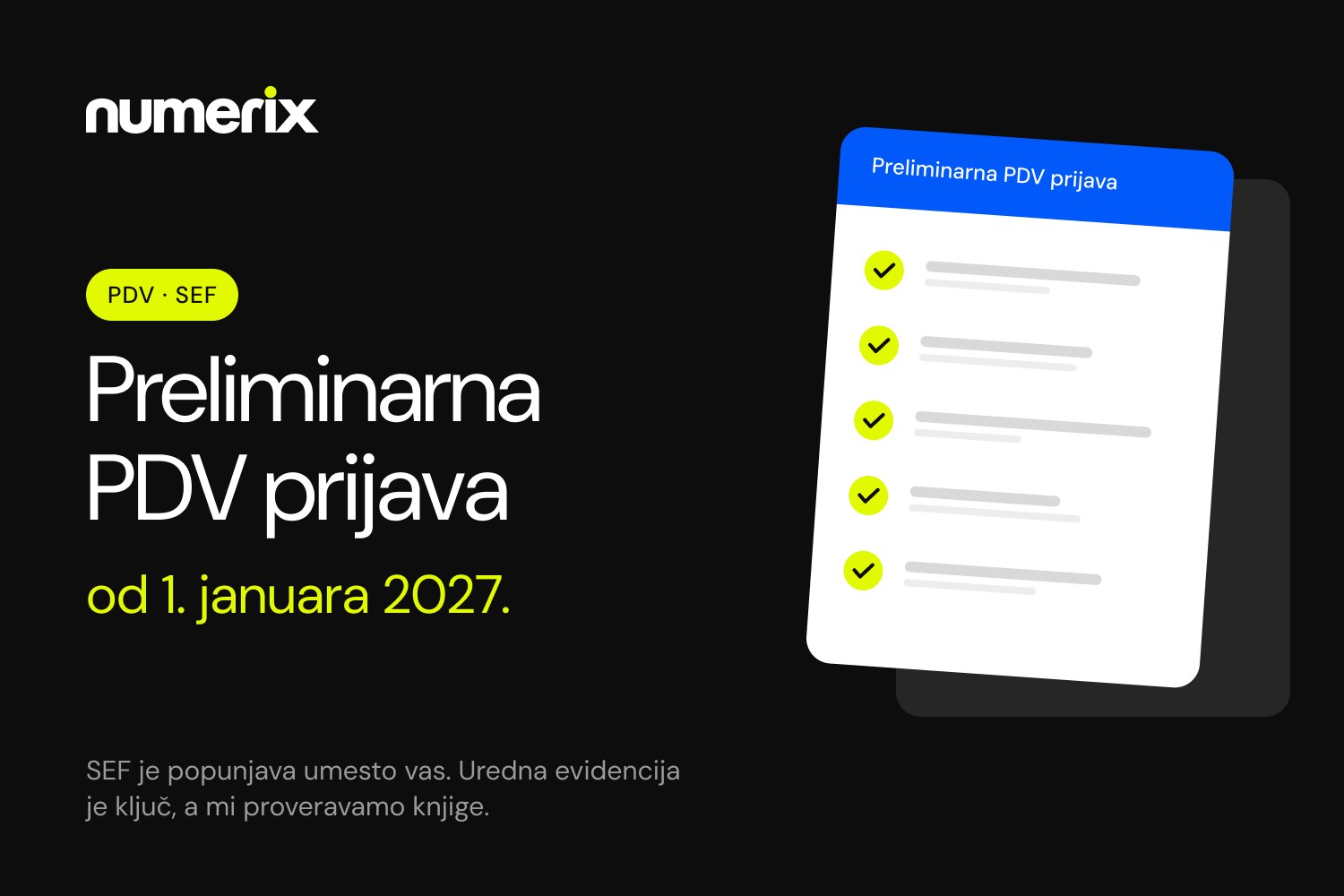
From the January 2027 tax period (or January–March 2027 for quarterly taxpayers) SEF prepares a preliminary VAT return (PPP PDV, with Annex 1 and Annex 2) from e-invoices, individual and summary VAT records, and the input VAT record. The preliminary return is filed as an annex to the VAT return. The POPDV form is no longer filed for those periods.
If you do not file the EPP by the 12th and the preliminary return is prepared after that deadline, zero is entered in the Annex 1 fields for which SEF has no data. If you do not file the VAT return within the deadline, the Tax Administration files it ex officio, on the basis of the preliminary return, and that return contains only output VAT, with no input VAT.
In addition, for tax periods from January 2027 (or January–March 2027 for quarterly taxpayers) tighter rules apply to working with EPP together with the preliminary return:
- if the preliminary return is prepared after the EPP deadline (the 12th), the EPP can no longer be filed, only corrected or updated;
- on the day the preliminary return is submitted to the tax authority, after submission, neither correction nor updating is possible;
- after the VAT return has been filed on time, only a correction is possible, without updating.
Orderly records by the 12th are therefore, from 2027, more than a formality: they determine what the state will see in the preliminary return.
Checklist before the deadline
For each tax period, check:
- Have all incoming e-invoices for that period been accepted or rejected, and no later than the 10th?
- Have all internal invoices (foreign person and VAT payer) been drawn up, also no later than the 10th, if you want the deduction in that period?
- Do the EPP and the VAT calculation record have the status “recorded” no later than the 12th?
- If you file the EPP on the 11th or the 12th, did all internal invoices have the status “recorded” (evidentirano) by the 10th, and were all e-invoices already in SEF?
- Do the EPP and the books agree before you file the VAT return on the 15th?
The most common reason input VAT “slips” by one period is not the form itself, but an invoice left unanswered or an internal invoice drawn up after the 10th.
Why this matters if you keep the books yourself
These three deadlines reward order during the month, not a rush before the return. If you work in SEF every day — accepting invoices, drawing up internal invoices and keeping the records up to date — the 10th, 12th and 15th become a check, not a race. That is the model we believe in at Numerix: you keep your books with modern tools, and we review them professionally before the data become a return.
From 2027 that review matters even more. SEF fills in Annex 1 of the preliminary return automatically from e-invoices and records, so Annex 1 will be only as accurate as the records in SEF.
In brief
- The 10th is the deadline for deducting input VAT: accept the e-invoice and draw up the internal invoice no later than the day before the VAT return is filed, and no later than the 10th.
- The 12th is the deadline for all SEF records — EPP and the VAT calculation record, including the internal invoice. If you file the EPP on the 11th or the 12th, the data are taken as at the 10th.
- The 15th is the deadline for the VAT return and payment.
- EPP is mandatory even when you have no right to deduct.
- A SEF user draws up the internal invoice in SEF, from the April 2026 period onwards.
- If you miss the deadline (the day before the VAT return is filed, and no later than the 10th), the deduction moves to a later period; the right expires after five years.
- From January 2027, EPP feeds the preliminary VAT return. If you do not file the EPP by the 12th and the preliminary return is prepared after that deadline, zero is entered in the Annex 1 fields for which SEF has no data. If you do not file the VAT return within the deadline, the Tax Administration files it ex officio with only output VAT, and no input VAT.
Want the 10th, 12th and 15th to pass without surprises?
If you are not sure whether your incoming invoices, internal invoices and input VAT record are aligned, get in touch. The Numerix team can review your SEF and books for one period and show you where the differences are — before the deadline, and before those differences enter the preliminary return from 2027. You can read more on the Tax consulting page or through the Tax Health Check.
This article is for information only and does not constitute a tax opinion for a specific case. The rules are stated as at 18 November 2026.